Main information:

Linderhof Park

Gardens and park buildings

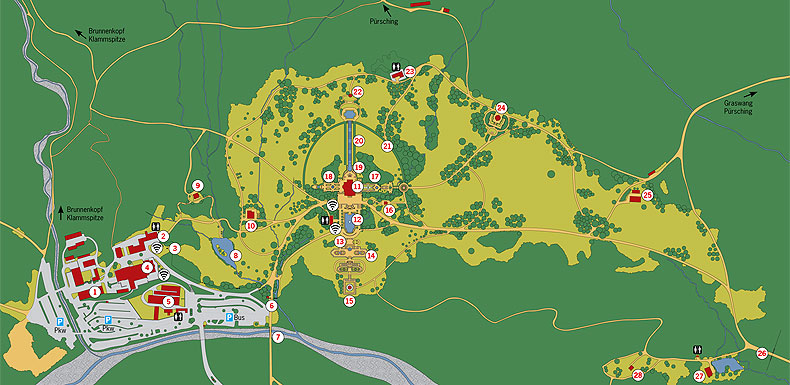
Plan of Linderhof Park

Plan of Linderhof Park external link enlarged version of the plan (plus legend)


Historical gate with porter's lodge and historical bridge
(plan numbers 6,7)
This was the original entrance to the park for staff and guests.


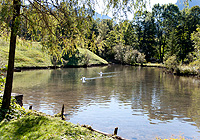
Swan pond (plan number 8)
Artificial pond, created as a design feature in the landscape garden.


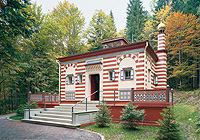
Picture: Moroccan House

Moroccan House
internal link Click on the
picture to enlarge

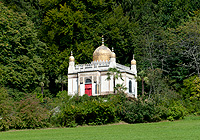
Moroccan House (plan number 9)

The pavilion, acquired at the World Exhibition in Paris in 1878, was remodelled inside at Ludwig II's request and originally built on the Stockalpe near the Austrian border.

The wooden building, acquired by a private individual after the king's death, was bought back by the state in 1980 and was reconstructed in the palace park in 1998.


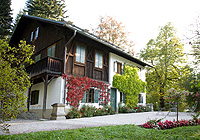
Royal Lodge (plan number 10)

Picture: Royal Lodge

Royal Lodge
internal link Click on the
picture to enlarge

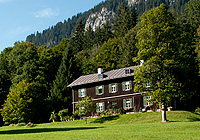
The building, which dates from 1790, was originally located where the palace is now, and was moved at the king's request in 1874. It had already been used by Maximilian II, Ludwig's father, as a hunting lodge. Ludwig II lived in it frequently before the palace was completed, and after the king's death it was often used by Prince Regent Luitpold.

Today's exhibition in the Royal Lodge covers topics such as the building’s origins as a farm, its use by the royal family and its significance as a planning office for Ludwig II’s many building projects.


Water Parterre and linden tree (plan numbers 12, 13)

Picture: Palace with Water Parterre

Palace, Water Parterre
and linden tree
internal link Click on the
picture to enlarge

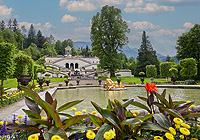
The geometric garden area surrounded by hornbeam hedges is dominated by a large pool with the gilt fountain group "Flora and putti". The fountain, operated solely through the pressure of the natural gradient, can rise up to 22 m into the air. The massive tree that disturbs the geometry of the design, a linden tree around 300 years old, is said to have given the farm originally on this site – and hence also the palace – its name. At the time of Ludwig II there was a seat in the tree.


Picture: Back of the palace with a view of the Temple of Venus

The back of the
palace with a view
of the Temple of 
Venus
internal link Click on the
picture to enlarge

Terrace Gardens (plan number 14)

The three terraces on the slope known as the "Linderbichl" were designed in the Italianate garden style.

Among the decorative features are two lions of cast zinc and the Naiad Fountain; on the stairs are numerous cast zinc vases and the ornamental flower beds are highlighted with bell-shaped fountains.

In the middle of the terrace complex is a grotto-like niche containing a bust of Queen Marie Antoinette of France.


Picture: Sculpture of Venus

Sculpture of Venus
internal link Click on the
picture to enlarge

Temple of Venus (plan number 15)

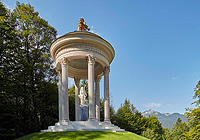
The crowning feature of the terraces is a round Greek temple with a larger than life-sized marble figure of Venus, flanked by two putti. 

A theatre was originally planned for this site.


Picture: St Anna's Chapel

St Anna's Chapel
internal link Click on the
picture to enlarge

St Anna's Chapel (plan number 16)

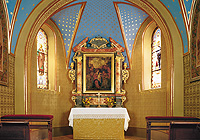
The oldest building in the Linderhof palace complex is St Anna's Chapel, built in 1684 by the Ettal abbot Roman Schretler.

The interior of the little church, dedicated to the mother of Mary, was redesigned and fitted with stained glass windows under Ludwig II.


Eastern Parterre (plan number 17)

Picture: View of the palace and parterre from the east

View of the palace
and parterre
from the east
internal link Click on the
picture to enlarge

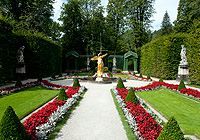
This garden area, on three levels, consists of ornamental flowerbeds with allegories of the four elements on the long sides.

The French influence is noticeable in the stone sculpture "Venus and Adonis", the fountain with the gilt figure of "Amor shooting an arrow" and the stone bust of King Louis XVI of France.


Western Parterre (plan number 18)

Picture: Western Parterre

Western Parterre
internal link Click on the
picture to enlarge


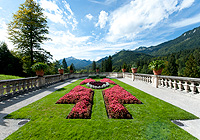
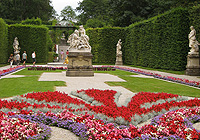
Completed in 1872 as the first of the palace's gardens, the Western Parterre with its colourful flowerbeds is dominated by two gilt fountain figures, Fama, the goddess of fame, and Amor, the god of love, accompanied by dolphins.

With stone figures symbolizing the four seasons, majolica vases from the Nymphenburg Manufactory and a bust of King Louis XIV of France, this area of the garden is particularly decorative.


Picture: Cascade with Neptun Fountain

Neptun Fountain
internal link Click on the
picture to enlarge

Cascade with Neptun Fountain (plan numbers 19, 20)

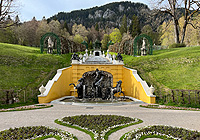
The steep slopes rising towards the "Hennenkopf" on the north side of the palace were used to create a cascade, which flows over 30 steps and is decorated with stone vases. Flanking the artificial waterfall are linden pergolas with stone figures symbolizing the four continents at either end.

At the bottom of the cascade is a pool with a Neptune group spouting water and a flowerbed in the shape of a Bourbon lily.


Picture: Music Pavilion

Music Pavilion
internal link Click on the
picture to enlarge

Music Pavilion (plan number 22)

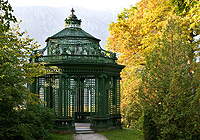
At the top end of the cascade is a large wooden pavilion looking across the palace and gardens from the north to the Temple of Venus with the Kuchelberg behind it.


Grotto (plan number 23)

Picture: Grotto

Grotto
internal link Click on the
picture to enlarge

The artificial dripstone cave with its lake and waterfall was modelled on the Hörselberg from the first act of the Wagner opera "Tannhäuser". This natural stage, built in 1876/77 by the landscape sculptor A. Dirigl, was lit by arc lights. The electricity for this was generated by 24 dynamos in the machine house 100 m away, one of the first electricity works in Bavaria.
The grotto features a "royal seat", a Lorelei rock and a gilt boat in the shape of a shell.


Picture: Moorish Kiosk

Moorish Kiosk
internal link Click on the
picture to enlarge

Moorish Kiosk (plan number 24)

This was built in 1867 as the Prussian contribution to the World Exhibition in Paris. In 1870 the "railway king" Henry Strousberg bought the pavilion.

After Strousberg's bankruptcy, Ludwig II bought the building in 1876 for Linderhof Palace Park and had it rebuilt and reappointed to his specifications.


Picture: Former quarters of the building site supervisory staff

Former quarters
of the building site
supervisory staff
internal link Click on the
picture to enlarge

Former quarters of the building site supervisory staff (plan number 25)

This building housed the offices of the architects and building supervisors during the construction of the palace and park. In order to make optimal use of the daylight, the house was fitted with large windows, an unusual feature in this part of the country.


"Forbidden Gate" (plan number 26)
This entrance was reserved solely for the king and led via a wooden bridge over the river Linder to the road to Ettal.


Hunding's Hut (plan number 27)

Picture: Hunding's Hut

Hunding's Hut
internal link Click on the
picture to enlarge

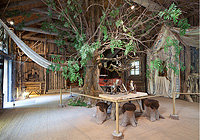
This building, originally erected in 1876 at the foot of the Kreuzspitze, was modelled on Hunding's dwelling in the first act of the "Walküre" from the "Ring des Nibelungen". 

In 1884 it was destroyed by fire and rebuilt in the same place and in the same form several months later. In 1945 it burned down again and was reconstructed elsewhere in the park in 1990.


Hermitage of Gurnemanz (plan number 28)

Picture: Hermitage of Gurnemanz

Hermitage of
Gurnemanz
internal link Click on the
picture to enlarge

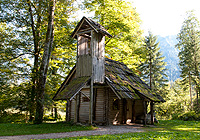
The "Hermitage of Gurnemanz" was modelled on the third act of the Wagner opera "Parsifal" and originally built near Hunding's Hut.

In the 1960s it fell into ruin, and was reconstructed in the park in 1999/2000 with the help of private donations.


| top |